Who makes the grade
EDITOR’S NOTE: Nineteen students in a fall 2025 Clemson University journalism course completed four interrelated stories about recent changes in food grade safety inspections conducted by the state Department of Agriculture. The project class was taught by Senior Lecturer Mike Pulley in the English Department and sponsored by the university’s Pearce Center for Professional Communication and its Client-Based Program. The students obtained food grade inspection data from the state’s website, converted it to a Microsoft Excel spreadsheet and analyzed the data for the 517 restaurants in Pickens County using advanced Excel formulas.
Pickens County restaurant owners and managers don’t always agree on what changed after the shift of food safety inspections from the state Department of Health and Environmental Control to the state Department of Agriculture on July 1, 2024.
Some believe new inspectors are tougher while others barely noticed a difference, butmost agree inspections aren’t happening as often.
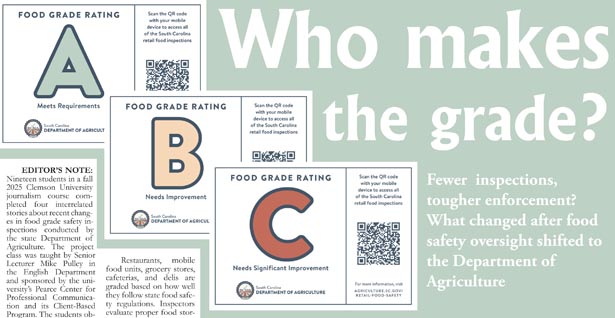
Restaurants, mobile food units, grocery stores, cafeterias, and delis are graded based on how well they follow state food safety regulations. Inspectors evaluate proper food storage, equipment sanitation, temperature control, employee hygiene, and food sources. Establishments receive a letter grade of A, B, or C.
“Most consumers recognize the importance of seeing an A posted on a restaurant’s door as a sign of strong food safety practices,” said Kimberly Baker, Clemson Extension food systems and safety program team director.
Food safety regulations provide the science-based practices necessary to minimize the risk of foodborne illness outbreaks in retail food settings.
The Courier analyzed restaurant food grades data for inspections conducted by the Agriculture Department from April 2019 through September 2025. The database itself is managed by the state Department of Public Health.
In the first half of 2024, prior to Agriculture’s takeover, DHEC completed approximately 300 inspections in Pickens County. In the first six months of 2025, Agriculture completed approximately 33% less inspections.
Agriculture has around 110 inspectors statewide, according to Derek Underwood, deputy commissioner for the Department of Agriculture. Each inspector covers approximately 280 establishments. A goal for the department is to hire seven to eight additional inspectors. Currently, eight inspectors cover both Anderson and Pickens counties. Pickens County has about 517 eating establishments.
Sandra Craig, director of Retail Food Safety at the Department of Agriculture, said the change in inspection numbers could be due to the transition process since her department took over the job in 2024. Inspectors in the Agriculture Department had to be trained on different software systems. On-the-job training takes around a year for retail inspectors, according to Underwood.
“We want to continue to hire and train our inspectors so that they can educate while they regulate,” Craig said.
Reports from Agriculture show enforcement actions by the department increased statewide since its 2024 takeover. Simultaneously, data from Agriculture reveals the number of A grades given to restaurants also increased, while the number of B and C grades slightly decreased.
Roughly 2,000 new retail food establishments were created statewide since 2024, and that could explain the difference in grades, Underwood said. Other factors to consider include the software changes, the new inspector training, and the hiring of additional employees.
In May 2023, legislation dissolved DHEC and reassigned its duties to new and existing agencies such as the state department of Public Health, Environmental Services, and Agriculture. This change aimed to consolidate oversight, according to Hank Davis of the South Carolina Restaurant and Lodging Association.
“That was the biggest thing—to make sure that [Agriculture] was more responsive, had additional resources and was better equipped to support the state’s second largest employer,” Davis said.
After the 2024 takeover, Agriculture switched to an “enforcement referral process” that is more detailed than DHEC’s, Underwood said. This initiative targets restaurants that repeatedly put public health at risk, also known as habitual or chronic violators.
If a violation is noted, an automatic follow-up inspection occurs within 5-10 days to gauge if deficiencies were corrected. Consecutive violations can result in enforcement through the use of permit suspension orders.
“That’s why those follow-up inspections are critical … to ensure that those [violations] are not repeated in subsequent inspections–that’s the key,” Davis said.
After three referrals for the same violation, Agriculture can suspend the restaurant’s permit for five to ten days. An eatery’s license can be revoked after multiple suspensions.
In the first six months of 2025, Agriculture issued six suspensions to establishments, based on published reports. None of these suspensions were in Pickens County. Statewide, DHEC issued zero suspensions in the first six months of 2024, according to Underwood.
Despite no change in inspection codes, some restaurant owners believe food safety grading is stricter and less forgiving.
Clemson University students Rylee Cowan, Grace Dumit, Morgan Lennox, Maddie Sapp, and Cole Warms contributed to the reporting on this story.