Category Archives: Lifestyles
Ancestral Civil War Letters (part 2)
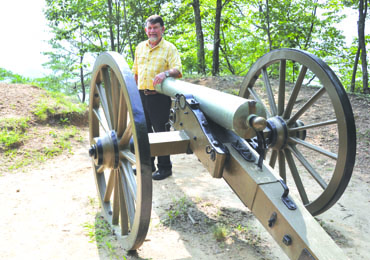
The author at Cumberland Gap, location of Confederate Fort Raines, where Mark Cloer wrote.
Doubt, decline and the destiny of duty
By Dr. Tom Cloer, Special to the Courier
Editor’s Note: This is the second of a two-part series on Civil War letters from Courier contributor Dr. Thomas Cloer Jr.
The next Civil War letter is from the oldest Cloer ancestors for whom I have personal letters. John B. Cloer and Aggatha S Cloer are my great-great-great-grandparents. How moving it is for me to see the precious handwriting of these old calloused hands! They were writing just before Christmas 1862 to their son in the Civil War. They mentioned that their son, Mark, had written that he had reunited with his Company. Mark had obviously come home for a November 1862 visit, as he had talked about doing in his correspondence.
Notice the information in this letter about salt. Why would this be important? Coffee, tea, sugar and salt were in very short supply in the mountains during the Civil War. Many of the mountaineers even used okra seeds for coffee during this time. Molasses was used for sugar, but salt was a very different matter. My brother, Nat, and I, growing up in Southern Appalachia during the 1940s and ‘50s, were responsible
Ancestral Civil War Letters
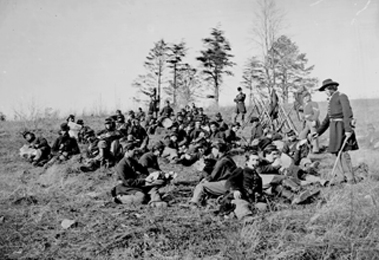
During their down time, Civil War soldiers often spent time writing letters to their loved ones, even though many of them never received proper schooling.
Editor’s Note: This is the first of a two-part series on Civil War letters from Courier contributor Dr. Thomas Cloer Jr.
By Dr. Thomas Cloer, Jr. – Special to The Courier
How many mementos do you have of your grandfather? I have two or three, and cherish them as if the objects were solid gold. I have one object that belonged to my great-grandfather, Jacob Miller Cloer, a tool he used in making wooden white oak shingles for roofs. It very well could have been used by his daddy, William Marcus (Mark) Cloer, the Confederate soldier described in this article. These Civil War letters are like that tool. For my grandchildren, these letters go back eight generations!
Introduction
Pickens and Oconee counties of South Carolina contain part of the Blue Ridge Escarpment that joins the rugged mountains of South Carolina with the Appalachian Mountains of North America, running from Georgia to Maine. The writers of these Civil War letters lived in mountainous, undeveloped Macon County, N.C. Macon County includes the mountain towns of Highlands and Franklin, lying immediately northwest of our beautiful South Carolina mountains.
There is one question I had to try to answer before sitting down and doing the most tedious, but for me
Mother’s Day: A history — Mother’s Day is this Sunday

Only recently dubbed “Mother’s Day,” the highly traditional practice of honoring of Motherhood is rooted in antiquity, and past rites typically had strong symbolic and spiritual overtones; societies tended to celebrate Goddesses and symbols rather than actual Mothers.
One of the earliest historical records of a society celebrating a Mother deity is found among the ancient Egyptians, who held an annual festival to honor the goddess Isis, who was commonly regarded as the Mother of the pharaohs.
The festival of Isis was also celebrated by the Romans, who used the event to commemorate an important battle and mark the beginning of Winter. Yet the Roman root of Mother’s Day is perhaps
a hidden treasure
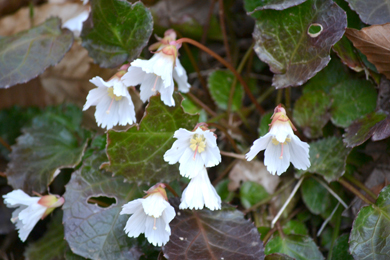
Don’t miss the blooming
of the rare Oconee Bells
By Olivia Fowler, Courier Staff
A trip to the Jocassee wilderness is more than a journey of a few miles. It’s a passage into another time.
What may be most striking upon arrival is the quiet. There are no motors running, cellphones ringing, people shouting or any other intrusive sounds.
An unpaved road is the only way in, and the terrain is more than a little rough. But anyone worth their salt will not be discouraged. There are about 200
30th annual Azalea Fest coming up this weekend
SPECIAL SECTION IN THIS WEEK’S PAPER
PICK UP ONE TODAY
FOR ALL FESTIVAL INFORMATION
PICKENS — Spring has always been special in Pickens County, with warm, sunny days and cool crisps evenings. And the third weekend in April offers the best way for area residents and visitors to Pickens County to say goodbye to the chills of winter with a two-day event filled with activities to thrill all age groups.
The 30th annual Azalea Festival, slated for April 18-19, is shaping up to be a
The turkey rut
By Dennis Chastain
For The Courier

Just like deer, wild turkeys have a rut season fueled by testosterone. Hunters can easily turn that information to their advantage.
Nothing gets a deer hunter excited like the coming of the rut. That’s the magical time of the year when thick-necked bucks are overcome with love lust and do stupid things like standing out in the middle of a cow pasture at midday, crashing through shopping center windows and chasing does around right in front of deer stands. Well guess what — there’s a wild turkey rut too.
This has long been a pet theory of mine, and now after 30 years of chasing wild turkeys from the mountains to the sea, I can tell you that it is true. Most long-time turkey hunters are aware that there are days during the month of April when there is nothing you can do to pull in a gobbler, and there are days when all you have to do is holler “come here turkey” and they’ll come running.
It’s all about testosterone, the male hormone that is both a curse and a blessing. Whether you’re a wily white-tailed buck, a lovestruck teenage boy or a mature wild turkey gobbler, testosterone has the ability to take over your brain and make you do things that you would not ordinarily do. Testosterone can get you in trouble. More deer are taken during the rut in South Carolina than any other time of the five-month-long season. It’s testosterone that drives the rut, in both deer and turkeys. And like the deer rut, the turkey rut comes and goes in various stages.
There is the pre-rut, the rut and the post-rut. The trick to taking advantage of the turkey rut is recognizing what stage the gobblers are in where you are hunting. Here are some signs to look for.
If it’s still near April Fool’s Day and you can’t raise a gobble with an owl hoot or a crow call, it’s the pre-rut. If you’re standing out there on a fine warm spring morning at first light and there are turkeys gobbling at crows, woodpeckers and car horns, the rut is on. On the other hand, if it’s toward the end of the season and it’s a silent spring out there — in other words, you can’t buy a gobble — the turkeys are in the post-rut blues.
So, how do you turn all this to your advantage? Well, depending on which stage of rut you determine the turkeys are in, adjust your hunting strategy accordingly. During the pre-rut, the turkeys are more interested in food and security than in breeding. Set up in areas where the sign indicates they have been feeding or scratching.
If all indications are that the turkey rut is on, get ready. Never call until you are ready to set up or you have already set up in front of a big tree with your gun up. I have had turkeys during the rut fly straight from the roost to right where I was calling from. I have also had testosterone-pumped turkeys fly off the roost and literally come running in. It pays to be ready.
Finally, if all indications are that the gobblers are in the post-rut doldrums — just like cooking good barbecue, the secret to success is to take it low and slow. Don’t be aggressive. Don’t push the turkeys. Use low, soft clucks, purrs and yelps. Be patient. It may take a turkey an hour or more to amble over your way. One good strategy during the post rut is to just go to a place with lots of scratching in the leaves or in the woods adjacent to a lush green food plot, and just sit up right there until you get a response. Just be advised that sometimes lackluster gobblers will silently sneak in from behind to check things out. Keep in mind the Boy Scout motto — be prepared.
Heard, not seen
All about the big ol’ bullfrog
By Scott Stegenga
For The Courier
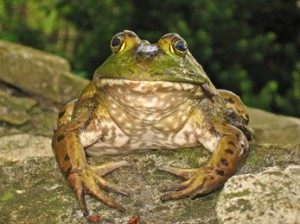
More likely to be heard than seen, bullfrogs’ eyeballs are raised above their skulls so they can stay almost totally submerged and still be aware of their surroundings.
Anyone who has spent even a little time near the shore of a lake or pond has probably encountered a bullfrog now and then. They are more likely to be heard than seen. In the Upstate, bullfrogs are the largest frog in their family, reaching a length of 6 inches or more. Smaller species in the same family are the leopard, pickerel and green frog.
A bullfrog is perfectly suited for its aquatic habitat. The frog’s color is a plain green or a mottled gray or brown pattern on a greenish background, providing excellent camouflage among
How to protect natural animal habitats
Though birds or other small animals may routinely gather on your property, what if you one day looked out and saw a black bear lapping up water in your swimming pool? That’s what happened to Cheryl Pawelski of Altadena, Calif., in the hills not far from Los Angeles, during the summer of 2013. After losing interest in the water, the bear retreated to the hills.
In early 2014, a woman in Cicero, N.Y., saw three coyotes in her backyard while taking her dogs outside for their morning walk. And while people who live near the Florida everglades are accustomed to seeing alligators, a woman in Skyesville, Md., was surprised to find one roaming
Mounted Ministries offers horseback riding with a higher purpose
Mounted Ministries is a nonprofit 501(c)3 religious horseback riding organization in Pickens. The group offers “Christ-Centered Riding” using horses rescued from neglect or that were unwanted/donated.
Founder Cathy Childers is also a horse trainer and riding instructor who refers to her rescued horses as “The Redeemed.”
“After the horses are rehabilitated and retrained, some are made available to loving forever homes through an adoption process,” Childers said.
Others, she said, are used for ministry purposes as she teaches children, youth and adults more than just how to ride. She uses the horse’s behavior to illustrate biblical principals on a variety of
Exploring spiritual formation outdoors
Southern Wesleyan offers course
on wilderness spirituality
CENTRAL — This past fall, Southern Wesleyan University offered a new course devoted to the spiritual benefits gained from a solitary wilderness experience and a temporary retreat from an increasingly connected, urbanized society.
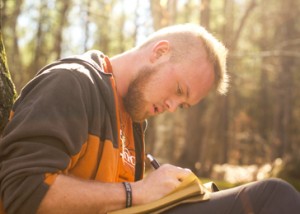
Jonathan Stegenga, a Southern Wesleyan University junior from northern Pickens County, jots down some thoughts in his notebook while spending time alone in a wooded area. This past fall, Southern Wesleyan University offered a new course devoted to the spiritual benefits gained from a solitary wilderness experience and a temporary retreat from an increasingly connected, urbanized society.
Wilderness is a locale used frequently throughout the Bible, two prominent instances being the Israelites’ 40 years of wandering in the desert and Jesus going up to an isolated mountaintop to pray. Monastic orders built monasteries in isolated areas for sacred activities.
Dr. Rocky Nation, professor of biology at Southern Wesleyan University, developed “Wilderness